What's the Difference Between CCA and Ahr Ratings in Batteries ?
Understanding the difference between starter batteries, deep cycle auxiliary batteries, and factory dual starter battery systems will help you choose the right battery setup for your touring or camping adventures.
Starter Batteries (CCA)
A starter battery is designed for one purpose – starting your engine.
When you turn the key or press the start button, your starter motor demands an enormous amount of current over a very short period of time.
A quality starter battery can deliver hundreds of amps instantly before immediately being recharged by the alternator.
This is where CCA (Cold Cranking Amps) comes into play.
CCA measures how much current a battery can supply for 30 seconds at -18°C while maintaining enough voltage to crank an engine. Although Australia rarely experiences these temperatures, CCA has become the universal way of comparing a battery's starting performance.
The higher the CCA rating, the more cranking power the battery can provide. This is especially important for large diesel engines with high compression ratios that require considerably more effort to start.
What a starter battery is not designed for is being repeatedly discharged over long periods. Running a fridge, lights or camping accessories from a starter battery can significantly shorten its lifespan and may even leave you stranded with a flat battery.
Deep Cycle Batteries (Ah)
A deep cycle battery has a completely different job.
Instead of providing a huge burst of power for a few seconds, it's designed to deliver a steady supply of power over many hours.
Rather than being rated by CCA, deep cycle batteries are rated in Amp Hours (Ah).
An Amp Hour rating tells you roughly how much energy the battery can store.
For example:
A 100Ah battery could theoretically supply 5 amps for around 20 hours.
Or 2 amps for approximately 50 hours.
Or 10 amps for around 10 hours.
Real-world performance varies depending on battery type, temperature and how deeply it's discharged, but the Ah rating provides a useful comparison of battery capacity.
Deep cycle batteries are built with thicker lead plates (in AGM batteries) or different internal chemistry (in lithium batteries), allowing them to be repeatedly discharged and recharged without suffering the damage that a starter battery would experience.
This makes them ideal for powering:
Portable fridges
Camp lighting
Water pumps
12V outlets
Phone and camera charging
Air compressors (short-term)
Inverters
Camping accessories
Factory Dual Starter Batteries
Some vehicles leave the factory with two starter batteries, but this does not automatically mean they're fitted with a camping dual battery system or an "auxiliary" battery system.
For example :
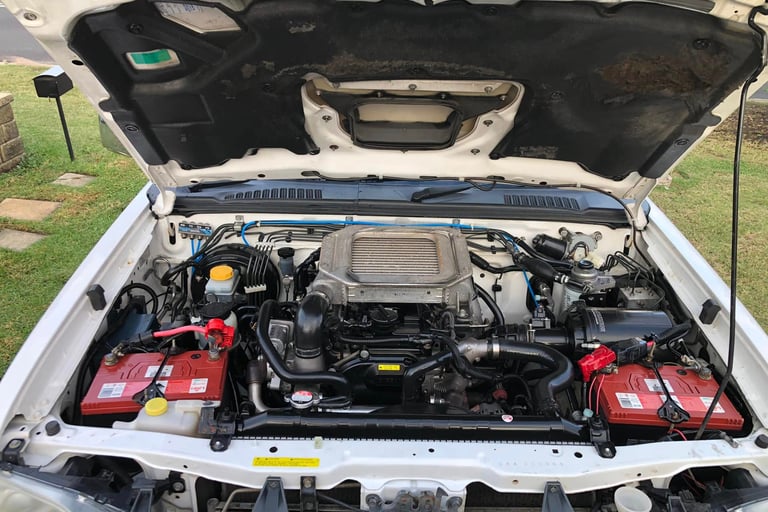
The Nissan D22 Navara ( certain diesel models ) came with with twin factory starter batteries ( like mine ).
The Toyota 200 Series V8 LandCruiser also uses two factory starter batteries.
These batteries are permanently connected together and operate as one large starter battery.
The reason is simple.
Large diesel engines require enormous cranking power. Cold climates, high-compression engines and additional factory electrical loads all place greater demand on the starting system, so manufacturers fit two starter batteries to increase available cranking current and starting reliability.
Both batteries start the engine.
Both batteries are charged together.
Neither battery is intended to run camping equipment while the engine is switched off.
If you leave your fridge connected to either of these batteries overnight, you'll simply flatten both batteries—and potentially won't be going anywhere in the morning.
What Is a True Auxiliary Battery System?
A genuine auxiliary battery system adds a separate deep cycle battery that's dedicated to powering your camping accessories.
This battery is isolated from the starter battery (or starter batteries) using a DC-DC charger or battery management system.
When the engine is running:
The alternator charges the starter battery first.
Once that's satisfied, the auxiliary battery is charged.
When the engine is switched off:
The starter battery remains protected.
All camping accessories draw power only from the auxiliary battery.
This means you can comfortably run your fridge, lights and other accessories overnight without risking your ability to start the vehicle the next morning.
My Own Setup
My Nissan D22 Navara is a perfect example.
It has three batteries in total.
The two factory batteries are starter batteries. They're permanently linked together and exist solely to crank the diesel engine.
I then have a third battery—a 120Ah AGM deep cycle auxiliary battery—installed specifically for camping.
This auxiliary battery powers:
My 12V fridge, running 24 hours a day.
Camp lighting.
USB charging.
Camera batteries.
Phones and tablets.
Other 12V camping accessories.
Because it's completely isolated from the starter batteries, I can camp for days knowing my vehicle will still start when it's time to head home.
In Simple Terms
Think of it like this:
A starter battery is like a Usain Bolt — an incredible burst of power over a very short distance.
A deep cycle battery is like a marathon runner — it delivers steady, reliable power over a long period of time.
Both are excellent at what they're designed to do—but neither should be expected to do the other's job.
Choosing the correct battery for the correct application is one of the most important investments you can make in a reliable touring or camping setup.
Understanding Starter Batteries, Dual Battery & Auxiliary Systems
One of the biggest misconceptions in the 4WD and camping world is that any or every vehicle with two batteries has a "dual battery system."
In reality, that's not always the case.
OUR ADDRESS
wherever my adventure takes me
CONTACT US
WORKING HOURS
always
MENU


scan QR to SUBSCRIBE