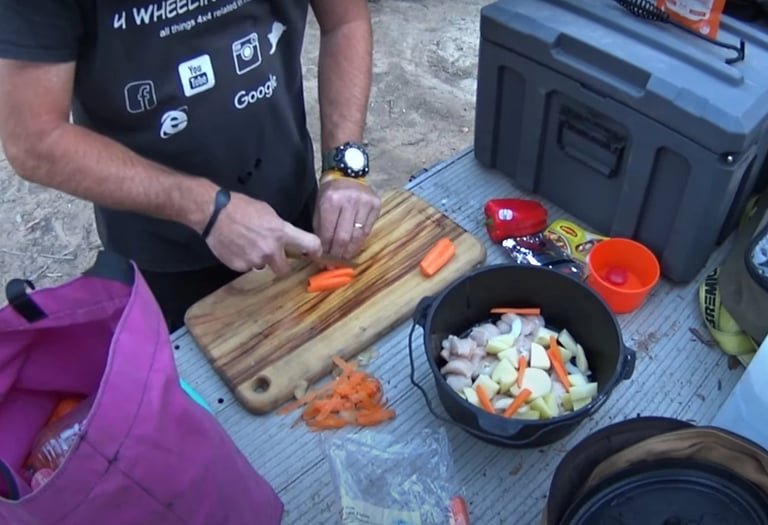
Cooking at camp ... there's nothing better
Here is the page I enjoy the most – food glorious food !
You’ll find a small selection of recipes here that are delicious, quick and very easy
to cook in your camp oven while in the great outdoors.
The best thing with camp oven cooking too is that they’re like a slow cooker at
home in that you load them up with your ingredients and then you can sit back,
relax and enjoy the camp fire while it cooks away in the background.
I am currently putting together some fantastic easy to cook camp recipes as we
speak, so please bear with us and check back here shortly.
Simply click here to print off your PDF recipe for your next camp trip away !
At the bottom of this page, you’ll find a small selection of recipes here that are delicious, quick and very easy to cook in your camp oven while in the great outdoors.
The best thing with camp oven cooking too is that they’re like a slow cooker at home in that you load them up with your ingredients and then you can sit back, relax and enjoy the camp fire while it cooks away in the background.
Should you have any recipes you would like to share, I encourage it with open arms.
I am currently putting together some fantastic easy to cook camp recipes as we speak, so please bear with us and check back here shortly.
Simply click here to print off your PDF recipe for your next camp trip away !
Should you have any recipes you would like to share, I encourage it with open arms.
Tips for your camp oven ...
* TIP : TEMPERATURE CONTROL
( all temperatures referred to here are in Celsius )
Exactly how hot is your camp oven ?
If you don’t have a thermometer to check it out, try this simple trick :
Take a piece of newspaper or paper towel and drop it in ( onto a trivet, so it isn’t sitting on the bottom which is sitting on hot coals ) and allow it to cook for five minutes. Its condition after that time will give you a fair idea of the temperature.
• if the paper is black and smoking, the oven is too hot.
• if the paper is dark brown, the oven is very hot ( 230 degrees ).
• if the paper is light brown, the oven is hot ( 200 degrees ).
• if the paper is yellowish, the oven is moderate ( 180 degrees )
• if the paper is gone, pack up and head home !
A ‘very hot’ oven of around 230 degrees will burn things to an inedible blackened crisp, bit like your first attempt at cooking a barbie' when you first left home !
For food requiring short cooking times or for browning, such as pizza, biscuits or pies, a hot oven of about 200 degrees works well, with the majority of coals on top.
The most common temperature required in camp oven cooking is what would be called a moderate oven, with a temperature of around 170° to 180° degrees.
For stews and casseroles, you want a ‘slow’ oven, similar to a traditional slow cooker at home – approx. 150°. Slow and low for pulled porks, stews and casseroles etc.
Probably the most common mistake many people make is having their oven too hot. Not far behind that would be where they have too too much heat underneath, especially with flat - bottomed camp ovens that sit flat on the coals. This will often lead to very well done bottoms on dampers and scones.
Your best bet is to place half a shovel of coals on the ground creating a hot pad if you like for your camp oven to nestle on. Then place some coals on top also. This way it pushes heat down from the lid and heat up from underneath - effectively making this like a miniature fan forced oven that you have at home. Don't overload the top otherwise, you'll end up with burnt damper on top instead of the bottom.
It is a balancing act to begin with however the more practice, the better you'll get with it and you'll be cooking like a pro in no time.
When you check the food inside, be quick as hot air rises and wants to escape out the miniute you open the lid.
Check damper after, approx. 20 minutes and a baked dinner, like a roast and vegies after 30 minutes.
Any time you have to remove the lid, even partially, rotate as you put it back on to make sure it’s seated back down properly and the heat can’t escape.
Remember, when cooking outside there are many environmental factors which will change the outcomes from day to day.
Wind will blow heat away, cooler ambient temperature, humidity variations, and the size of a fire nearby will all have an influence, so check your food and be prepared to vary cooking times to suit.
If the day is windy or cool, you can assist by digging a shallow hole, deep enough for your lower coals to sit in, to shelter them from the air movement when you place your oven on top. Or even better, build a low circular wall around the fire so the fire is down lower than ground level and then if you have a tripod, you can set it across the fire utilising a chain to hang your camp oven from, adjusting the temperature by increasing or decreasing the length of chain above the oven.
Don't forget too that often your camp kitchen, utensils and cookware are subject to wet or damp dew conditions. Remember, once you're ready to pack up and go home, give your camp oven a very light spray of good quality olive oil ( or similar ) on the inside and outside - the lid and all - and then lightly rub in removing any excess with a clean cloth. This is good preventative "maintenance" to stop the oven forming any rust whilst in storage until your next trip away. Do this and you'll have a very reliable bit of gear for years to come.

OUR ADDRESS
wherever my adventure takes me
CONTACT US
WORKING HOURS
always