
One of the most common questions people ask when setting up a camping power system is, "what size battery do I need ?"
The answer depends entirely on how much power you'll be using each day.
The first step is to make a list of everything that will be connected to your battery and estimate how many amps each item draws. Common items include your fridge, camp lights, phone chargers, tablets, fans, water pumps, diesel heaters, CPAP machines, and any other 12V accessories. Once you know the current draw of each item and roughly how many hours per day they'll be used, you can calculate your daily power consumption in A/h or amp-hours.
For example :
Fridge : 2.5A average draw x 24 hours = 60 A/h per day
Camp lights : 1A x 4 hours = 4 A/h per day
Phone charging : 2 A/h per day
Water pump and accessories : 4 A/h per day
Total daily usage = 70 A/h
Once you've added everything together, it's a good idea to include an additional 10% buffer. This allows for unexpected power usage, hotter weather causing your fridge to work harder, battery ageing, or simply forgetting about the odd accessory that gets plugged in.
So in this case, you would ideally want a battery with at least 77 A/h of usable capacity. If you're using a lithium battery, a 100 A/h battery would comfortably cover your needs as you can draw them down by 80% of their capacity.
If you're using a AGM battery, remember that only around 50% maximum of its rated capacity should be regularly used to maximise battery life, meaning you may need a significantly larger battery to achieve the same usable amount of power.
Keep in mind too that a good quality fridge with quality insulation will generally be cycling on around 50% of the time too, so they're not running continuously. That needs to be taken into consideration when calculating your overall total power consumption.
Also consider how long you'll be camping between recharging. If you're staying off-grid for several days without solar or vehicle charging, you'll need enough battery capacity to cover multiple days of usage. Solar panels, DC-DC chargers and regular driving can all reduce the size of battery required by replenishing power each day.
Solar panels, whether in traditional rigid glass designs or modern folding styles, have become much more affordable in recent years. As a result, reliable off-grid power is now within reach of most campers and is well worth considering for anyone looking to extend their time in the bush without worrying about battery capacity.
The key takeaway is simple : calculate the power draw of everything you intend to run, add up the daily amp-hour consumption, include a 10% safety margin, and then choose a battery that provides at least that much usable capacity.
Spending a little time doing the maths before buying can save you from flat batteries and disappointing weekends away.
Regarding 12v fridges specifically ...
Fridges are probably considered as one of the most important accessories for modern day camping and the choice is endless.
Most reputable brand 12v fridges will have an amp draw rating that indicates their average power consumption. These figures are typically determined under controlled testing conditions, allowing manufacturers to provide consistent comparisons across their respective fridge range.
It's important to remember though that real-world performance can and will usually differ from these published figures. Factors such as ambient temperature, how often and how long the fridge is opened, thermostat settings, and how full the fridge is can all affect power consumption. For example, a fridge working hard during a hot summer day will generally use more power than it would during a controlled laboratory test or when camping in cooler weather. An empty fridge will also draw more power as it will run more frequently to aid in cooling a large empty space. The more cold items in the fridge, the less empty space and the less the fridge has to work. Effectively, the items help keep each other cool by minimising the empty space around them.
While these ratings shouldn't be viewed as an exact prediction of power usage in every situation, they do provide a useful guide when estimating the battery capacity you'll need for your camping setup.
Why do fridges draw power ? ...
Unlike a basic simple traditional cooler box like a YETTI or an Esky and the like, 12v fridges have a flurry of electronics' running them and just like with your 240v fridge at home, 12v fridges "cycle" - that is when the fridge compressor turns off and then turns back on.
This cycling is controlled by the temperature setting and the thermostat which work hand in hand together. Each time the fridge compressor turns back on, it will have a temporary and minimal spike in its power draw before dropping down slightly where it usually remains until the internal compartment cools' back down. Once that temperature is reached and under control, the compressor then turns back off, that's essentially the cycle. You'll often hear your fridge cycle on and off throughout the day and night, the same way you hear your house fridge do this. When calculating your fridges power consumption too, keep in mind that your fridge averages 50% of the time on and the other 50% off - generally. Not an exact scientific formulation but a good rough guide.
This cycling is where your fridge can draw considerable power from your battery however it is also something that can be controlled, to a certain extent, by how you use your fridge.
How to assist control cycling ...
A fridge will work for you as hard as it has to in order to keep you food and drinks cool and at a fairly stable set temperature. Fluctuations happen however, there are certain things you can do, or habits more so that you can get into, to help your fridge ( and your battery ) lighten the load - no pun intended.
Think of your fridge at home, how you treat it and then compare that to your 12v car fridge.
Do you open your home fridge 30 times a day ?
Do you open your fridge and leave it open whilst making a drink ?
Do you open your home fridge without any idea of what you're intending to get out ?
Probably not ...
So why do it to your car fridge ? - a fridge that is working with less stable power power ( 12v ) and in the harshest environment of all, summer heat outdoor !
Simple things you can do to help it are :
open it with a plan of what you're intending to grab out ...
try to open it only far enough to grab out what you need ...
open it only when necessary ( you would be surprised... ) ...
close the lid as quickly as possible once you have out the items you need otherwise you're letting all that cool air escape ...
try to keep your fridge full for longer ... even if you throw some bottles of water in there as your other contents are being consumed as that will help keep the internals cooler therefore less cycling ...
and most of all, just try to keep the lid closed for as long as possible and as often as possible.
If there is an insulated bag option for your particular fridge, they're well worth considering as they can help maximise the fridges efficient, especially in warmer camping weather.
It's just simple common sense stuff and if you try these above practices, your fridge will work more efficiently, it won't be as hard on your battery and you'll find your food will last longer with less issues.
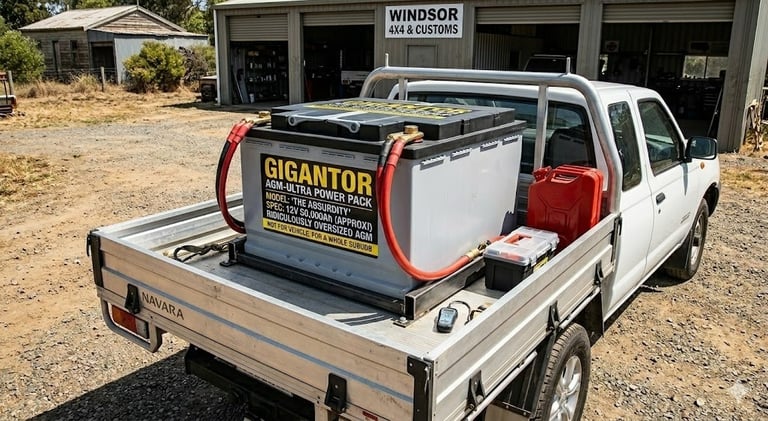
What Sized Battery Do I Need ?
OUR ADDRESS
wherever my adventure takes me
CONTACT US
WORKING HOURS
always
MENU


scan QR to SUBSCRIBE